
- US investment banking revenues rose 31 percent year over year in the first half of 2026, driven by strong Q1 M&A advisory and Q2 underwriting growth at Wall Street banks.
- In H1, Oppenheimer led advisory revenue growth with $121 million in fees, up 150 percent year over year, followed by Morgan Stanley with $1.78 billion, up 66 percent.
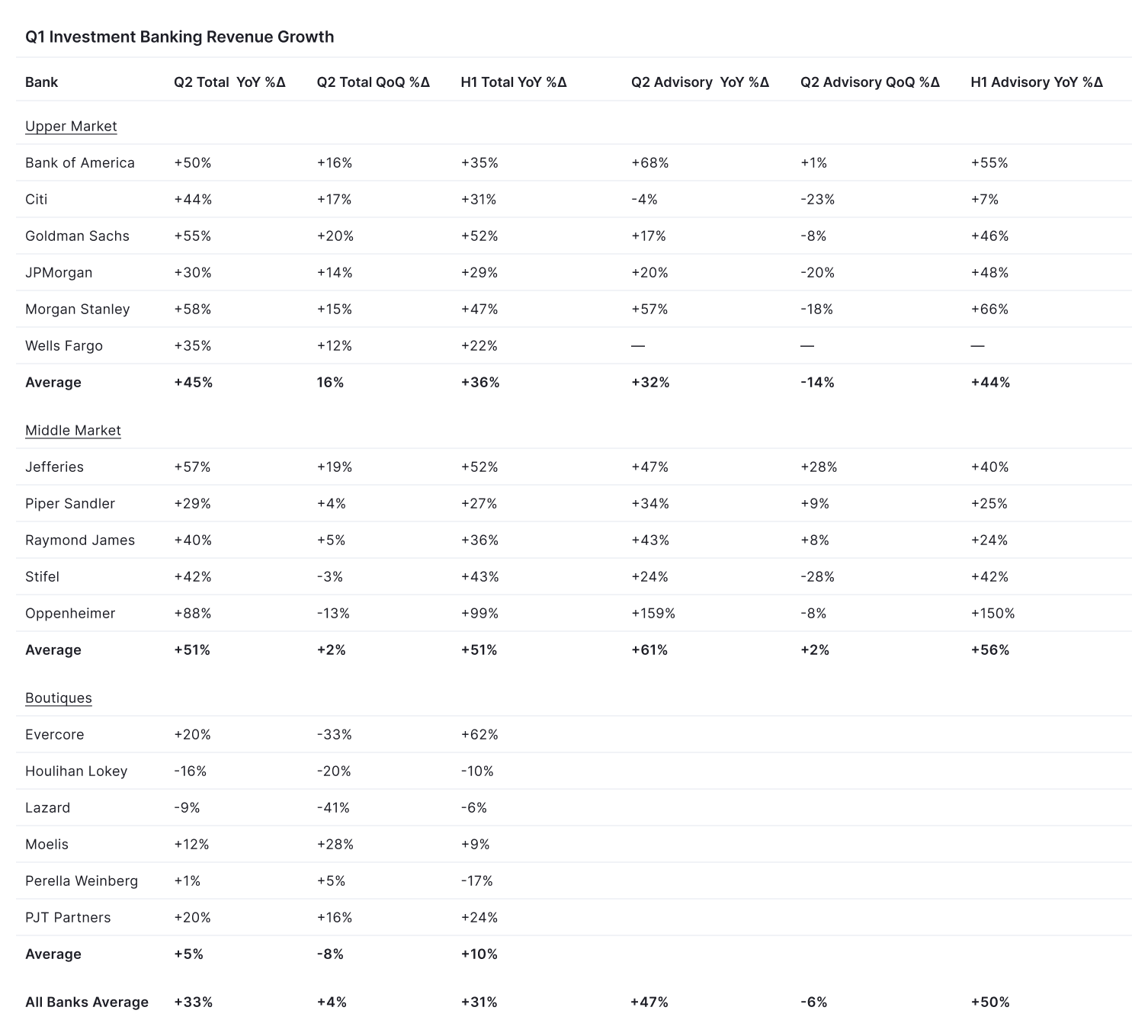
- Average H1 total revenue growth was 36 percent for upper-market banks, 51 percent in the middle market and 10 percent for boutiques.
US investment banking revenue increased 31 percent in the first half of 2026, driven by stronger M&A advisory activity in Q1 that waned in Q2, as underwriting revenue expanded at Wall St banks, according to the earnings reports of major US banks.
The same slowdown in M&A advisory was visible among boutique firms. Total revenue at boutique banks, where M&A advisory accounts for a larger share of investment banking activity, declined from the first quarter by 8 percent even while it rose by 10 percent during the first half.
Middle-market firms showed a similar pattern. Advisory-specific and total revenues increased just 2% from the first quarter, even while both were up 56 percent and 51 percent in the first half from a year earlier respectively.
These data are consistent with a deal market in which activity has become concentrated among larger transactions and a booming stock market.
In the US, there were 4,653 deals worth $1.2 trillion announced in the first five months of 2026, compared with 4,851 deals worth $603 billion during the same period a year earlier, according to PwC.
Thirty-nine transactions valued at $5 billion or more were announced during that period, more than 50% above year-earlier levels, while their combined value nearly tripled to $957 billion from $325 billion.
PwC said roughly a quarter of megadeals in both 2025 and 2026 were related to artificial intelligence, including transactions tied to the broader AI ecosystem such as data center construction and supply.
Globally, announced deal value reached about $3.5 trillion in the first half, with both the first and second quarters exceeding roughly $1.65 trillion, according to Bloomberg data. Deal count, however, fell 16% from the second half of 2025.
While public earnings reports suggest some strength among middle-market banks, they capture only a slice of the market. Earnings data exclude many smaller private banks that serve lower- and middle-market clients, where activity has been more exposed to a deal environment dominated by fewer, larger transactions.
PwC and others have noted that middle-market activity remained relatively sluggish in the first half despite some notable bright spots highlighted in earnings reports, with private equity firms struggling to exit companies acquired at peak valuations and strategic buyers remaining relatively more cautious about the economic outlook.
To stay up-to-date on the latest IB news and events, make sure to sign up for The Investment Banker’s Brief, a newsletter by MadeMarket purpose-built for investment bankers.
Looking more closely at earnings, during the first half of the year, investment banking advisory revenues at leading American firms in the upper and middle markets were up an average of 50 percent year-over-year.
Meanwhile, total revenues were up 31 percent reaching a total of $36 billion during the same period.
During that period, Oppenheimer and Morgan Stanley led the market in advisory-specific revenue growth.
Oppenheimer reported $121 million in advisory fees with a year-over-year gain of 150 percent and Morgan Stanley reported $1.78 billion with a year-over-year gain of 66 percent.
Meanwhile, among leading boutique firms, which often focus on M&A advisory across the upper and middle market, Evercore saw the largest growth year-over-year during the same period at 62 percent with $2.17 billion.
Overall, Oppenheimer reported the highest year-over-year growth in total investment banking revenues for the same period among all banks surveyed.
On average, total revenue growth came in at 36 percent for upper-market banks, 51 percent in the middle market, and 10 percent at boutique firms.
The Second Quarter
In the quarter ending on Jun. 30, Oppenheimer and Bank of America led the market in year-over-year advisory revenue growth.
Oppenheimer reported $58 million in advisory revenues with a year-over-year gain of 159 percent and Bank of America reported $558 million with a gain of 68 percent.
During the same period, Oppenheimer and Morgan Stanley led the market in total revenue growth year-over-year at 88 percent and 58 percent with $82 million and $2.34 billion, respectively.
Among leading boutique firms, Evercore and PJT Partners led in total revenue growth, both reporting year-over-year gains of 20 percent with $873 million and $486 million respectively.
Across the upper and middle markets, average total year-over-year growth in advisory revenues was 47 percent and average total growth in overall investment banking revenues, including boutique firms, was 33 percent for the same period.
On average, total revenue growth came in at 45 percent for upper-market banks, 51 percent in the middle market, and 5 percent for boutique firms.
Quarter-over-quarter, total fees in the upper market grew at 16 percent, 2 percent in the middle market, and dropped 8 percent among boutiques, while advisory revenues at upper and middle-market banks dropped 14 percent and remained relatively flat at 2 percent, respectively.
Upper-Market Banks
In the upper market, Morgan Stanley and Bank of America led in advisory revenue growth for the first half, reporting year-over-year gains of 66 percent and 55 percent respectively, while Citigroup ranked at the bottom with 7 percent.
For the second quarter, Bank of America and Morgan Stanley led in advisory revenue growth, reporting year-over-year gains of 68 percent and 57 percent respectively, while Citigroup ranked furthest behind with a 4 percent drop.
Quarter-over-quarter, Bank of America and Goldman Sachs led in advisory revenue growth during a weak quarter, reporting gains and the lowest losses of 1 percent and -8 percent respectively, while Citigroup ranked lowest with losses of 23 percent.
Middle-Market Banks
In the middle market, Oppenheimer and Stifel led in advisory revenue growth for the first half, reporting year-over-year gains of 150 percent and 42 percent respectively, while Raymond James ranked at the bottom with 24 percent.
For the second quarter, Oppenheimer and Jefferies led in advisory revenue growth, reporting year-over-year gains of 159 percent and 47 percent respectively, while Stifel ranked furthest behind with 24 percent.
Quarter-over-quarter, Jefferies and Piper Sandler led in advisory revenue growth, reporting 28 percent and 9 percent respectively, while Stifel ranked lowest with -28 percent.
Boutique Banks
Among boutiques, Evercore and PJT Partners led in total revenue growth for the first half, reporting year-over-year gains of 62 percent and 24 percent respectively, while Perella Weinberg ranked at the bottom with -17 percent.
For the second quarter, Evercore and PJT Partners again led in total revenue growth, both reporting year-over-year gains of 20 percent, while Houlihan Lokey ranked lowest with -16 percent.
Quarter-over-quarter, Moelis and PJT Partners led in total revenue growth, reporting gains of 28 percent and 16 percent respectively, while Lazard ranked at the bottom with -41 percent.
To stay up-to-date on the latest IB news and events, make sure to sign up for The Investment Banker’s Brief, a newsletter by MadeMarket purpose-built for investment bankers.